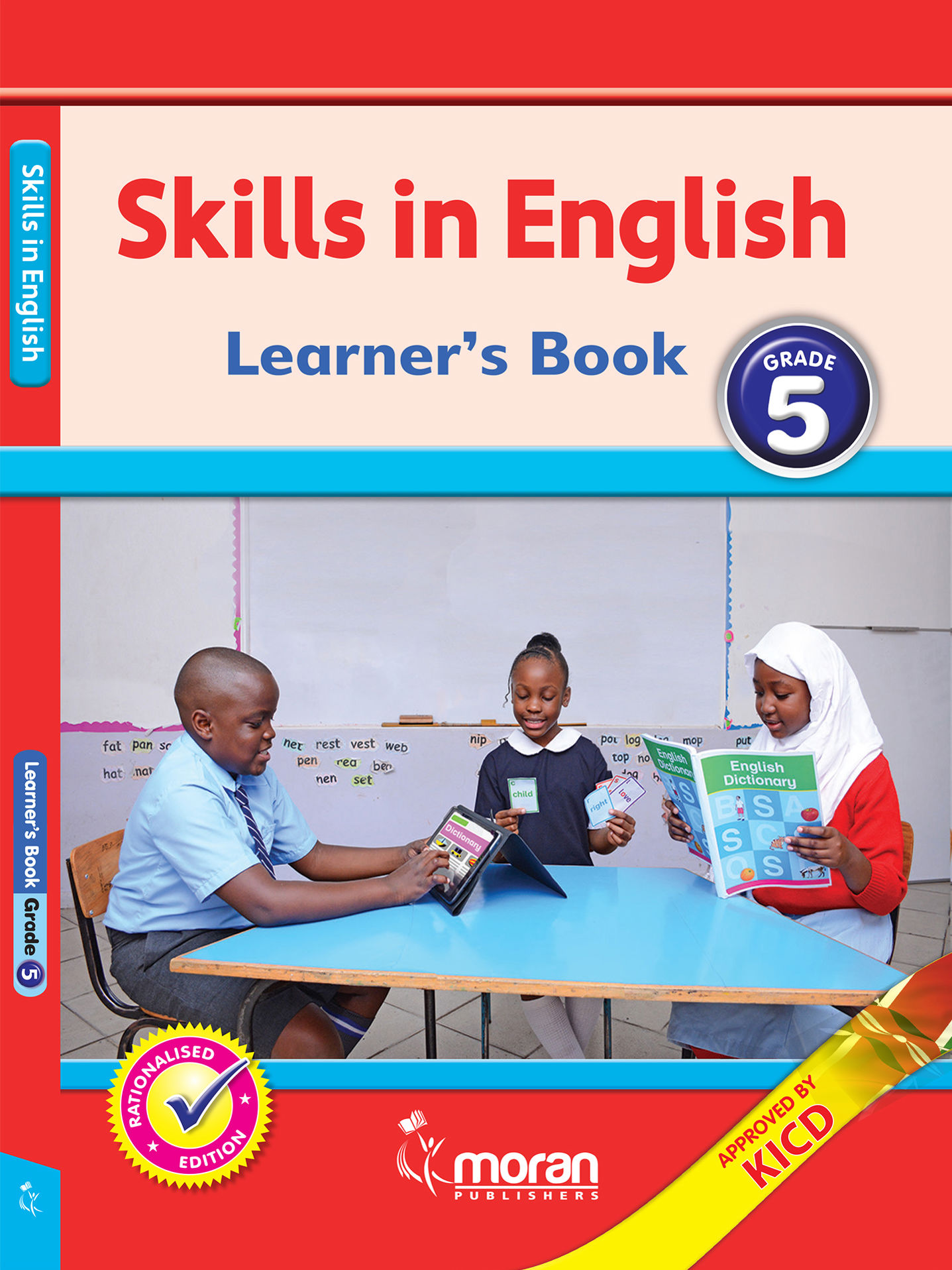
English Grade 5. Rationalised edition
Authors
Diane Omondi, Hukka Wario, Joseph Ndirangu, Maureen Kwamboka, Rosemary KaraniExercises kit’s authors
Diane Omondi, Hukka Wario, Joseph Ndirangu, Maureen Kwamboka, Rosemary KaraniPublisher
Included in packages
This is a complete English course developed in line with the Competency Based Curriculum. It offers appropriate skills, knowledge, values and attitudes necessary for learning English as a learning area and as a language of communication. The text is presented in a manner that stimulates learning. It employs an inquiry-based approach to learning in all activities which equips a learner with the necessary competences, skills and the quest to learn and discover.
The course:
• Encourages learning from known to unknown
• Uses teaching and learning resources available in the learner's immediate environment
• Involves the learner in activities that stimulate curiosity, compelling him or her to explore and discover
• Covers all the learning outcomes in the curriculum design
• Integrates core competences, values, attitudes and pertinent and contemporary issues
• Involves parents and guardians in the learning process
• Inspires the learner to develop the spirit of volunteerism towards improving the community
• Facilitates acquisition of the four language skills through practical problem-solving activities
• Utilises digital literacy to give the learner deeper understanding and relatable content.
1. Child Rights and Responsibilities. Happy children’s day
2. Child Rights and Responsibilities. The lost words
Lead |
Chapter |
|---|---|
| 2.1. | Listening and speaking. Oral narrative |
| 2.2. | Reading. Use of reference materials |
| 2.3. | Grammar. Use of this, that, these and those |
| 2.4. | Writing. Filling in forms |
3. National Celebrations. The party
Lead |
Chapter |
|---|---|
| 3.1. | Listening and speaking. Pronunciation and vocabulary |
| 3.2. | Reading. Oral narrative |
| 3.3. | Grammar. Collective nouns |
| 3.4. | Writing. Open-ended composition |
4. National Celebrations. We all celebrate
Lead |
Chapter |
|---|---|
| 4.1. | Listening and speaking. Dialogue |
| 4.2. | Reading. Poem |
| 4.3. | Grammar. Pronouns |
| 4.4. | Writing. Open-ended composition |
5. Etiquette – Table Manners. A promise is a promise
Lead |
Chapter |
|---|---|
| 5.1. | Listening and speaking. Polite words and phrases |
| 5.2. | Reading. Narrative |
| 5.3. | Grammar. Use of too ... to and too ... for |
| 5.4. | Writing. Handwriting |
6. Etiquette – Table Manners. Toti’s secret
Lead |
Chapter |
|---|---|
| 6.1. | Listening and speaking. Pronunciation and vocabulary |
| 6.2. | Reading. Narrative |
| 6.3. | Grammar. Use of must and should with an adverb |
| 6.4. | Writing. Handwriting |
7. Road Accidents – Prevention. Accident prevention
Lead |
Chapter |
|---|---|
| 7.1. | Listening and speaking. Pronunciation and vocabulary |
| 7.2. | Reading. Pictures and images |
| 7.3. | Grammar. Personal pronouns |
| 7.4. | Writing. A reply to a friendly letter |
8. Road Accidents – Prevention. Road safety
Lead |
Chapter |
|---|---|
| 8.1. | Listening and speaking. Pronunciation and vocabulary |
| 8.2. | Reading. Pictures and images |
| 8.3. | Grammar. Pronouns |
| 8.4. | Writing. A reply to a friendly letter |
9. Nutrition – Traditional Foods. Mission accomplished
Lead |
Chapter |
|---|---|
| 9.1. | Listening and speaking. Speech |
| 9.2. | Reading. Fiction and non-fiction materials |
| 9.3. | Grammar. Adjectives used for comparison |
| 9.4. | Writing. Narrative compositions |
10. Nutrition – Traditional Foods. What is on your plate?
Lead |
Chapter |
|---|---|
| 10.1. | Listening and speaking. Adjectives |
| 10.2. | Reading. Fiction and non-fiction materials |
| 10.3. | Grammar. Order of adjectives |
| 10.4. | Writing. Narrative compositions |
11. Jobs and Occupations – Various Occupations. What I can be
Lead |
Chapter |
|---|---|
| 11.1. | Listening and speaking. Pronunciation and vocabulary |
| 11.2. | Reading. Dialogues |
| 11.3. | Grammar. Use of each, a few, few, little and a little |
| 11.4. | Writing. Pictorial composition |
12. Jobs and Occupations – Various Occupations. A great teacher
13. Technology – Learning through Technology. Technology tells it all
14. Technology – Learning through Technology. Dear digital child
15. The Farm – Cash Crops. The plantation
Lead |
Chapter |
|---|---|
| 15.1. | Listening and speaking. Pronunciation and vocabulary |
| 15.2. | Reading. Fluency in reading |
| 15.3. | Grammar. Use of the double imperatives |
| 15.4. | Writing. Similes and proverbs |
16. The Farm – Cash Crops. The farm
Lead |
Chapter |
|---|---|
| 16.1. | Listening and speaking. Pronunciation and vocabulary |
| 16.2. | Reading. Reading fluency |
| 16.3. | Grammar. Question tags |
| 16.4. | Writing. Narrative composition |
17. Health – Communicable Diseases. Visiting a doctor
Lead |
Chapter |
|---|---|
| 17.1. | Listening and speaking. Speaking: Sounds |
| 17.2. | Reading. Descriptive texts |
| 17.3. | Grammar. Adverbs of manner, time, place and frequency |
| 17.4. | Writing. Apostrophe |
18. Health – Communicable Diseases. Wash your hands
Lead |
Chapter |
|---|---|
| 18.1. | Listening and speaking. Speaking fluency |
| 18.2. | Reading. Descriptive texts |
| 18.3. | Grammar. Use of How many ... could or would |
| 18.4. | Writing. Exclamation mark |
19. Leisure Time Activities. My hobby
Lead |
Chapter |
|---|---|
| 19.1. | Listening and speaking. Choral verse |
| 19.2. | Reading. Factual texts |
| 19.3. | Grammar. Conjunctions |
| 19.4. | Writing. Descriptive composition |
20. Leisure Time Activities. Too much television
Lead |
Chapter |
|---|---|
| 20.1. | Listening and speaking. Narrative in dialogue format |
| 20.2. | Reading. Factual texts |
| 20.3. | Grammar. Conjunctions |
| 20.4. | Writing. Descriptive composition |
21. Sports – Appreciating Talents. I am a sports champion
22. Sports – Appreciating Talents. Read using a digital device
Lead |
Chapter |
|---|---|
| 22.1. | Listening and speaking. Pronunciation and vocabulary |
| 22.2. | Reading. Reading with technology |
| 22.3. | Grammar. Interrogatives |
| 22.4. | Writing. Spelling |
23. Environmental Pollution. Please stop!
Lead |
Chapter |
|---|---|
| 23.1. | Listening and speaking. Pronunciation and vocabulary |
| 23.2. | Reading. Poems |
| 23.3. | Grammar. Nouns which only occur in singular or plural |
| 23.4. | Functional writing: Personal diary |
24. Environmental Pollution. A safe place
Lead |
Chapter |
|---|---|
| 24.1. | Listening and speaking. Making a speech |
| 24.2. | Reading. Songs and tongue twisters |
| 24.3. | Grammar. Nouns which only occur in singular or plural |
| 24.4. | Writing. Journals |
25. Money – Savings and Banking. A visit to Baliti Bank
Lead |
Chapter |
|---|---|
| 25.1. | Listening and speaking. Pronunciation and vocabulary |
| 25.2. | Reading. Variety of texts |
| 25.3. | Grammar. Prepositions of time, place and direction |
| 25.4. | Writing. Spelling |
26. Money – Savings and Banking. Why should I save money?
-
The study kit contains 104 chapters and 205 exercises of which 205 are in the chapters and 0 in the exercise stack.
-
Authors
Diane Omondi, Hukka Wario, Joseph Ndirangu, Maureen Kwamboka, Rosemary Karani -
Exercises kit’s authors
Diane Omondi, Hukka Wario, Joseph Ndirangu, Maureen Kwamboka, Rosemary Karani -
Subject
English -
Grade
Grade 5 -
Kit's language
English -
Publisher
Moran Publishers -
Included in packages