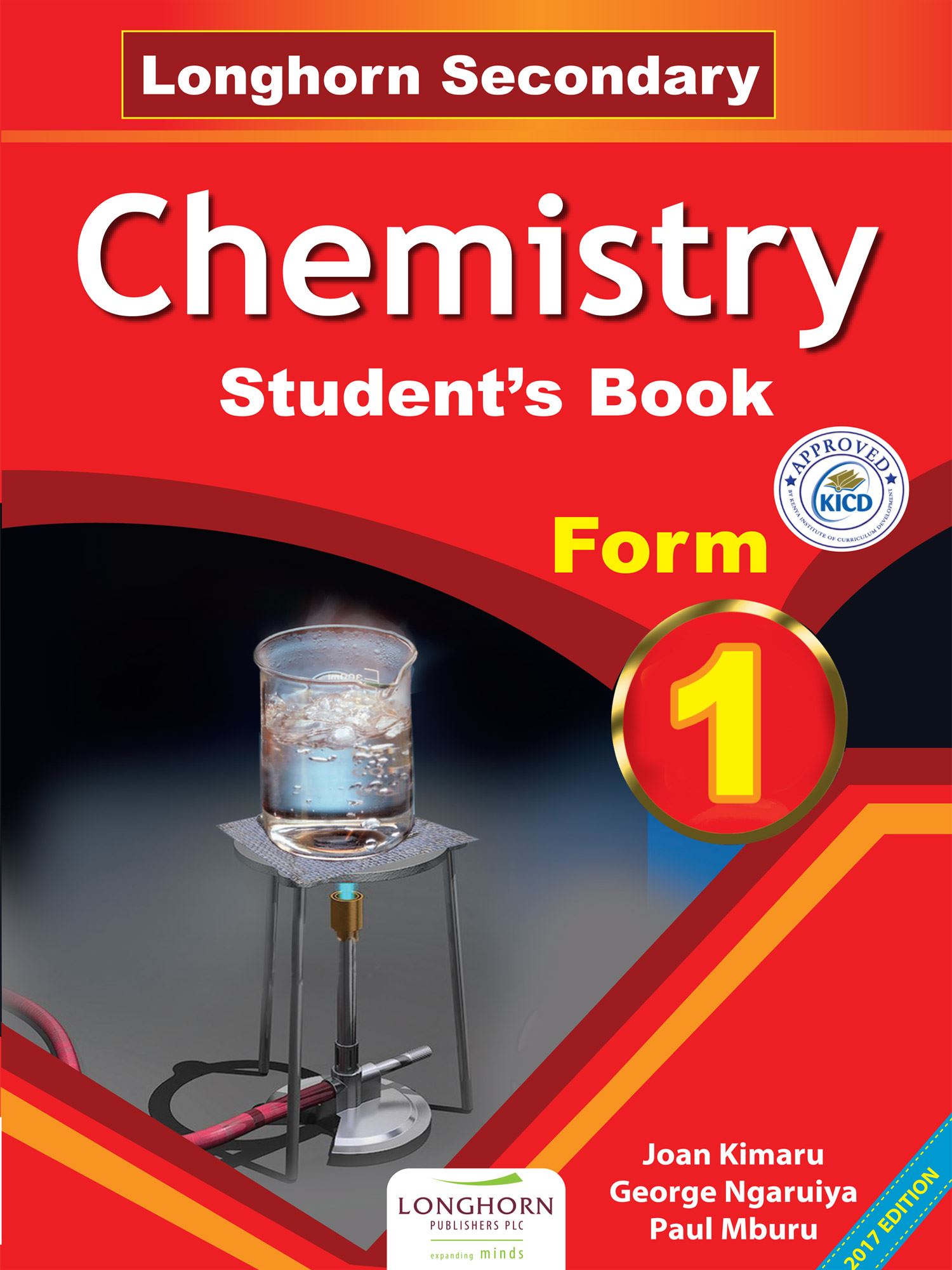
Authors
George Ngaruiya, Joan Kimaru, Paul MburuExercises kit’s authors
George Ngaruiya, Joan Kimaru, Paul MburuPublisher
Included in packages
Longhorn Secondary Chemistry Series makes learning Chemistry easier and enjoyable by:
• presenting the contents in well and logically organised topics which facilitate sequential transition from one concept to the next.
• presenting Chemistry as a practical subject where learning and development of skills and knowledge is mostly by discovery; way of experimental investigations.
• emphasising the use of the International Union of Pure and Applied chemistry (IUPAC) system of nomenclature while still retaining some of the commonly used nomenclature for the purpose of guiding in understanding.
• providing activities, exercises and projects in every topic which help in arriving at the desired logical conclusions.
• providing well guided experiments with apparatus carefully suggested for each activity.
• giving chances for self testing through revision exercises and self check tests.
• numerous and appropriate illustration of apparatus and experiment set ups.
1. Introduction to chemistry
Lead |
Chapter |
|---|---|
| 1.1. |
Introduction to chemistry
Free chapter! |
| 1.2. | Chemistry in society |
| 1.3. | The chemistry laboratory |
| 1.4. | End of unit |
2. Separation of mixtures
Lead |
Chapter |
|---|---|
| 2.1. | Types of mixtures |
| 2.2. | Separating an insoluble solid from a liquid |
| 2.3. | Separating immiscible liquids |
| 2.4. | Separating soluble substances from liquids |
| 2.5. | Sublimation |
| 2.6. | Chromatography |
| 2.7. | Solvent extraction |
| 2.8. | Crystallisation |
| 2.9. | Pure substances |
| 2.10. | End of unit |
3. Nature of matter and kinetic theory
Lead |
Chapter |
|---|---|
| 3.1. | The nature of matter |
| 3.2. | The effect of heat on substances |
| 3.3. | The kinetic theory of matter |
| 3.4. | End of unit |
4. Temporary and permanent changes
Lead |
Chapter |
|---|---|
| 4.1. | Temporary (physical) changes |
| 4.2. | Permanent (chemical) changes |
| 4.3. | End of unit |
5. Constituents of matter
Lead |
Chapter |
|---|---|
| 5.1. | Elements, atoms, molecules, compounds, and mixtures |
| 5.2. | Chemical symbols |
| 5.3. | Simple word equations |
| 5.4. | End of unit |
6. Acids, bases, and indicators
Lead |
Chapter |
|---|---|
| 6.1. | Acids and bases |
| 6.2. | Indicators and the pH scale |
| 6.3. | Properties of acids and bases |
| 6.4. | End of unit |
7. Air and combustion
8. Water and hydrogen
Lead |
Chapter |
|---|---|
| 8.1. | Water |
| 8.2. | The water cycle |
| 8.3. | Water pollution |
| 8.4. | The reactions of metals with water |
| 8.5. | Laboratory preparation and the properties of hydrogen |
| 8.6. | Oxidation and reduction |
| 8.7. | Uses of hydrogen |
| 8.8. | End of unit |
9. Extras
Lead |
Chapter |
|---|---|
| 9.1. | Definitions |
| 9.2. | Appendix I |
| 9.3. | Appendix II |
-
The study kit contains 54 chapters and 168 exercises of which 102 are in the chapters and 66 in the exercise stack.
-
Authors
George Ngaruiya, Joan Kimaru, Paul Mburu -
Exercises kit’s authors
George Ngaruiya, Joan Kimaru, Paul Mburu -
Subject
Chemistry -
Grade
Form 1 -
Kit's language
English -
Publisher
Longhorn Publishers -
Included in packages